
👋 Join our WeChat community
## Model Introduction **GLM-ASR-Nano-2512** is a robust, open-source speech recognition model with **1.5B parameters**. Designed for real-world complexity, it outperforms OpenAI Whisper V3 on multiple benchmarks while maintaining a compact size. Key capabilities include: * **Exceptional Dialect Support:** Beyond standard Mandarin and English, the model is highly optimized for **Cantonese (粤语)** and other dialects, effectively bridging the gap in dialectal speech recognition. * **Low-Volume Speech Robustness:** Specifically trained for **"Whisper/Quiet Speech"** scenarios. It captures and accurately transcribes extremely low-volume audio that traditional models often miss. * **SOTA Performance:** Achieves the **lowest average error rate (4.10)** among comparable open-source models, showing significant advantages in Chinese benchmarks (Wenet Meeting, Aishell-1, etc..). ## Benchmark We evaluated GLM-ASR-Nano against leading open-source and closed-source models. The results demonstrate that * *GLM-ASR-Nano (1.5B)** achieves superior performance, particularly in challenging acoustic environments. 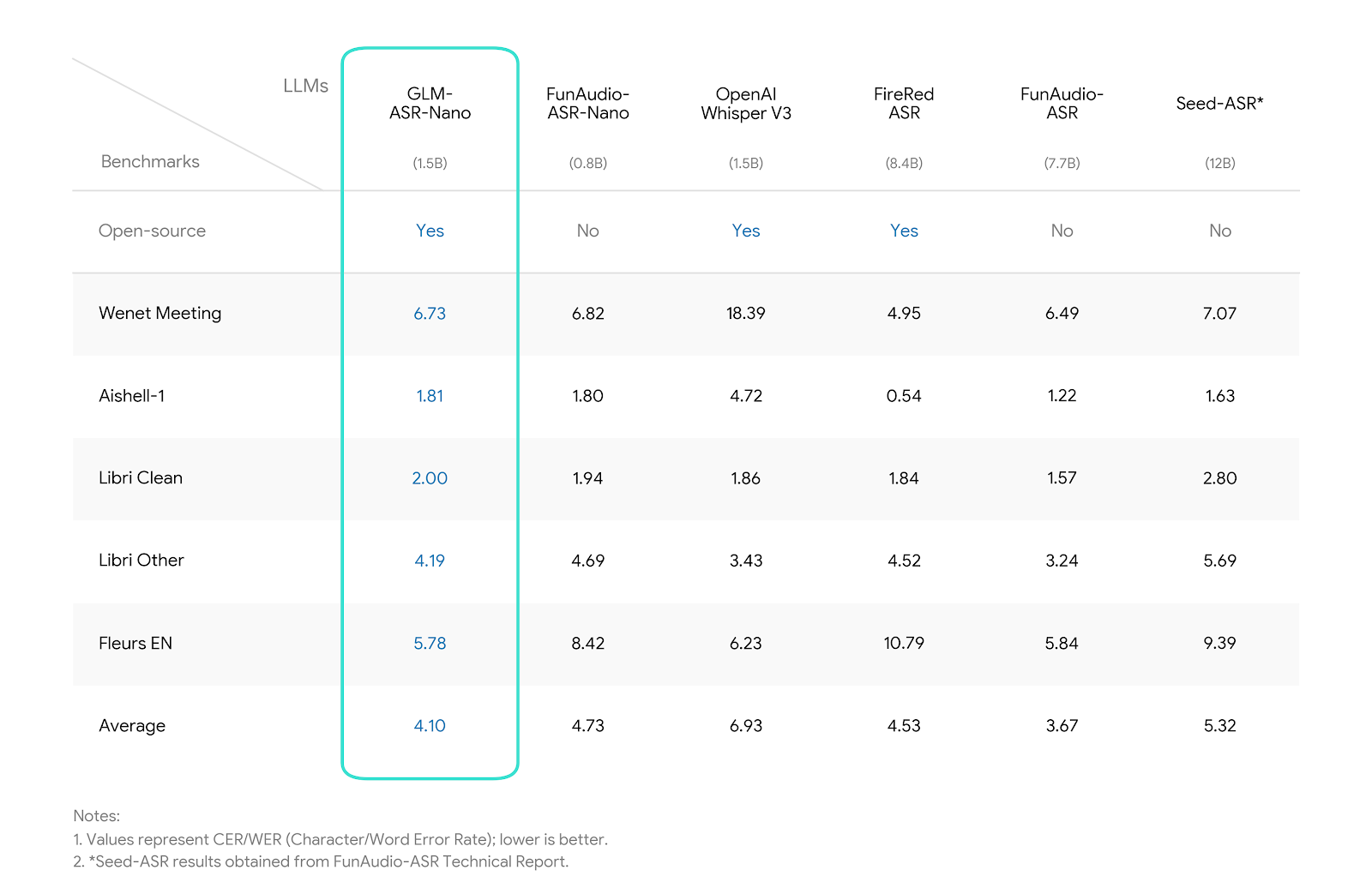 Notes: - Wenet Meeting reflects real-world meeting scenarios with noise and overlapping speech. - Aishell-1 is a standard Mandarin benchmark. ## Inference `GLM-ASR-Nano-2512` can be easily integrated using the `transformers` library. We will support `transformers 5.x` as well as inference frameworks such as `vLLM` and `SGLang`. you can check more code in [Github](https://github.com/zai-org/GLM-ASR). ### Transformers 🤗 Install `transformers` from source: ```bash pip install git+https://github.com/huggingface/transformers ``` #### Basic Usage ```python from transformers import AutoModelForSeq2SeqLM, AutoProcessor processor = AutoProcessor.from_pretrained("zai-org/GLM-ASR-Nano-2512") model = AutoModelForSeq2SeqLM.from_pretrained("zai-org/GLM-ASR-Nano-2512", dtype="auto", device_map="auto") inputs = processor.apply_transcription_request("https://huggingface.co/datasets/hf-internal-testing/dummy-audio-samples/resolve/main/bcn_weather.mp3") inputs = inputs.to(model.device, dtype=model.dtype) outputs = model.generate(**inputs, do_sample=False, max_new_tokens=500) decoded_outputs = processor.batch_decode(outputs[:, inputs.input_ids.shape[1] :], skip_special_tokens=True) print(decoded_outputs) ``` #### Using Audio Arrays Directly You can also use audio arrays directly: ```python from transformers import GlmAsrForConditionalGeneration, AutoProcessor from datasets import load_dataset from datasets import Audio processor = AutoProcessor.from_pretrained("zai-org/GLM-ASR-Nano-2512") model = GlmAsrForConditionalGeneration.from_pretrained("zai-org/GLM-ASR-Nano-2512", dtype="auto", device_map="auto") # loading audio directly from dataset ds = load_dataset("hf-internal-testing/librispeech_asr_dummy", "clean", split="validation") ds = ds.cast_column("audio", Audio(sampling_rate=processor.feature_extractor.sampling_rate)) audio_array = ds[0]["audio"]["array"] inputs = processor.apply_transcription_request(audio_array) inputs = inputs.to(model.device, dtype=model.dtype) outputs = model.generate(**inputs, do_sample=False, max_new_tokens=500) decoded_outputs = processor.batch_decode(outputs[:, inputs.input_ids.shape[1] :], skip_special_tokens=True) print(decoded_outputs) ``` #### Batched Inference You can process multiple audio files at once: ```python from transformers import GlmAsrForConditionalGeneration, AutoProcessor processor = AutoProcessor.from_pretrained("zai-org/GLM-ASR-Nano-2512") model = GlmAsrForConditionalGeneration.from_pretrained("zai-org/GLM-ASR-Nano-2512", dtype="auto", device_map="auto") inputs = processor.apply_transcription_request([ "https://huggingface.co/datasets/hf-internal-testing/dummy-audio-samples/resolve/main/bcn_weather.mp3", "https://huggingface.co/datasets/hf-internal-testing/dummy-audio-samples/resolve/main/obama.mp3", ]) inputs = inputs.to(model.device, dtype=model.dtype) outputs = model.generate(**inputs, do_sample=False, max_new_tokens=500) decoded_outputs = processor.batch_decode(outputs[:, inputs.input_ids.shape[1] :], skip_special_tokens=True) print(decoded_outputs) ```